1971 at a glance:
- Cigarette advertisements banned on TV
- "All in the Family" premieres on CBS featuring 1st toilet flush on TV
- "My Sweet Lord" by George Harrison hit #1 on UK pop chart
- The Provisional Irish Republican Army throw a time bomb into Springfield Road British Army base in Belfast, killing British Army Sergeant Michael Willetts and wounding seven officers
- Ed Sullivan's final TV show on CBS
- North Vietnam demands US end aid to South Vietnam
- George Harrison's concert for Bangladesh takes place in NYC on August 1
- 11 guards & 31 prisoners die in take over at Attica State Prison
I was fifteen and sixteen years old in 1971
1971 was a great year for me; I'd grown older, and within a year, my tastes and attitudes in my '70s life had changed. The stores all catered to '70s fashion, and being considered a "Hippie" was as common as Monday night football. This was an extraordinary year of discovery and change for me. I was getting older. At fifteen, I felt like I was 20 and all the games and toys I'd played with in the 60's no longer held any interest for me. We'd moved into an apartment complex where my parents had taken a management position. The building was called Cambridge Court in the black section of town. White tenants occupied about 60% of the building, but that was soon to change. In the summer of 1971, the area was a hotbed of activity. Neighbors left their doors open and parties were happening everywhere. I'd never smelled so much incense in one place in my entire life. It was all so different. Apartment renters were primarily very young; they weren't like our homeowner neighbors in other boroughs. This was an entirely new breed of people.
 New words were entered into my vocabulary. The first, and probably the most memorable, was "Narc". One of our neighbors, a very friendly and popular guy threw great parties almost every night. Of course, I was never invited because I didn't know him. One warm summer night, after the candied scent of vanilla incense wafted out of his open apartment door, and the sounds of "The Changeling" from The Doors' "L.A. Woman" album lit up the night, a typical Steve party came to a thunderous close.
As it turned out, he was dealing weed in fairly large quantities, and one of his best customers was an undercover narc. Steve's arrest was the hottest news in the complex and the event raised not only eyebrows, but a keen awareness within us all. This time, life was just like TV.
One Day of Freedom
It was April of 1971. Rain was coming down in typical Portland, Oregon fashion. In Portland the saying was: "April showers bring May showers." My brother Pat was twenty-one and staying with us briefly. He talked me into skipping school that day to hang out with him. I was a sophomore, and the more I thought about it, the better a notion it seemed. The first stop: cigarettes. He bought me a pack of Camel straights and for himself, he bought his brand.
 I chose the Camels because of how cool the package looked. Pat was experienced; he knew how to smoke. He could flip his Zippo lighter while driving, inhale with a pained ferocity, then courteously exhale out the side of his mouth like any pro on TV. As we drove around smoking cigrettes, and making stops here and there, we came across an odd little head shop.
The Head Shop
The smell of patchouli incense greeted us as we walked in. Hard rock music played and the whole place just oozed "cool". This particular shop had record albums without covers for only a dollar apiece. The records were in top condition; if a person didn't care about the covers they were worthy investments. I didn't have much money, so I bought the album "Best of Cream" housed only in its white paper sleeve.
 This shop also had a black light poster room which greatly impressed me. I couldn't believe how wonderful it was as I'd never seen a black light room before. I'd seen many black posters hanging on the walls of my friends' bedrooms, but never a literal gallery dedicated to the hanging and display of these psychedelic masterpieces.
A three-foot black light was mounted on the ceiling, and a thin black cheesecloth curtain hung in the doorway of the room separating it from the rest of the shop. From inside the store, you could see the darkened abyss behind the black cheesecloth with the bright neon colors glowing from the walls. It was the gateway to another world!
By the time we left this shop, we were low on gas and money. Gas was more important than anything else in Pat's estimation, so one last trip to the station was in order before heading back home. My parents both smoked, so smoking in the house without detection was easy. We smoked our cigarettes and listened faithfully to my new "Best of Cream" album. The mega-hit "Sunshine of Your Love" still blasted away on radio stations and was the first song on side one of this collection. Other tunes such as "Badge" and "White Room" renewed my faith in the power of the electric guitar.
The few and scattered events of that day were milestones in my career as a teenager. Instead of suffering through math class with the austere Mr. Brady, I was smoking cigarettes while cruising in Pat's super Chevy. Instead of English, I hung out at scrap yards noting discussions on engine performance. Instead of science class, I ate Twinkies while Pat roared his Chevelle at excessive speeds in what he considered to be cop-free zones. While I normally would have been in Mr. Funk's art class, I admired works rendered in fluorescent paint hanging on the walls of a dark museum; works painted by masters whose names would more than likely never be known.
Her Name was Cybill Shepherd
She broke down my defenses. She invaded my consciousness. She showed me that there was more to life than sophomore girls.
It wasn't until I'd seen a Cover Girl ad from 1971 that my eyes were treated to a devastating creature with thin lips, golden locks, and devil eyes. This lithe and spirituous beauty who haunted every single waking moment was named Cybill Shepherd. Her "everyday girl" look was a sweet mix of honey-blonde hair, and azure eyes. Having spent the bulk of my time drawing portraits of rock stars, I put the guitar slingers on the back burner long enough to put Cybill to paper.
I was actually a pretty good artist in high school having won an award.  I managed to finish it just in time, and Cybill Shepherd found her way to the hallway of our high school during an art exhibit. There's much more to this story here.
This event opened doors for me to be a much better artist. I learned to specialize in women's portraits, and to this day, I can thank Cybill Shepard for that. The Cybill affair was the longest two weeks of my life. She was eventually beaten out by a girl in my sophomore year math class.
Music raised my consciousness.
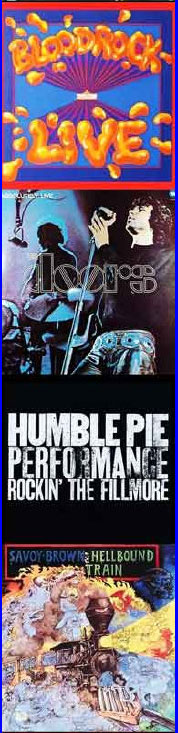
By 1971 I was completely immeresed in the more powerful rock music that was all around me. Rock groups were no longer stand-up cutouts on a TV show stage. They were insightful artisans, heavy metal slammers, precise musicians with tremendous skills. They wrote lyrics that ranged from the provocative to the profound. New rock and roll was a tremendous wave in the '70s, and has never seen a more artistic and impressionable era.
I was so far into The Doors at this time that I had almost completely lost track of my own identity. The music was cryptic, yet forged with a certain identifiable skill. It was pop, but it wasn't pop; it was soul, but it wasn't really soul.
I identified with Jim Morrison, not in the sense of being a famous singer, poet, artist, or whatever, but more in the sense of being a dark and misunderstood figure. "The End" was a journey down one of the darkest hallways of the human soul. I couldn't get it out of my head. Shortly after summer began, I purchased "The Doors Absolutely Live" and lived, ate, and breathed this LP until I'd had it memorized. The Doors were simply amazing. "The Celebration of the Lizard" finally had music to it, and was performed on this album.
Another Doors gem was "When the Music's Over". I used to listen to this song over and over again. By now I was hearing music that truly moved me, and made me ultimately proud of the generation I belonged to. It was no longer a simple matter of "long haired rock and roll," but a new revolution. Ironically, The Doors were a carry-over of the 60's "beat houses"—the beat generation clubs where goateed guys hit bongos and spouted obscure poetry. The Doors were doing the same thing only with music.
The vox keyboard was certainly outdated by this time, yet it was the heartbeat of the Doors' music. So how could they survive in the more progressive world of the '70s? The answer was simple; they were on the cutting edge of rock and Morrison always seemed to be floating on the stratosphere between reality and stage performance. It was all too beautiful, all too perfect. The Doors were it. Then, just before my birthday, I heard the ghastly news that on July 3, 1971, Jim Morrison had been pronounced dead.
"Hellbound Train" was an album whose cover drew me like a magnet. I hadn't yet heard that much from Savoy Brown with the exception of "I'm Tired". When I heard this LP, I was truly in love. Few songs are ever as good as "Lost and Lonely Child" or "If I Could See an End." This album literally drop-kicked the bass into another dimension, and on a fairly decent sound system, truly rocked the house. Neighbors would pop in and ask "Hey man, that's really heavy, who ya' listening to?"
 Buying albums was an incredible experience. I was understanding music like I'd never understood it before. It was powerful and raw, full of emotion. Long before Peter Frampton became a goldilocked heartthrob, he was a member of a great hard rock band called Humble Pie. Their album "Humble Pie Rockin' the Fillmore" was a hard-hitting example of what dynamite live performances should sound like. Their version of "I Don't Need No Doctor" was supreme.
Another great discovery was that of Bloodrock and the double live whammy modestly titled "Bloodrock Live". This was a great LP featuring some excellent tunes. "Castle of Thoughts", "Breach of Lease", and "Kool-Aid Kids" are all standout performances on this record.
The Girl Across the Street
I was about to embark on my first serious crush...
 I'd just turned 15 and we lived in pre-dominantly black neighborhood sandwiched in between North Williams and Vancouver avenues. Back in 1970, this area was quite different. Culturally, it was another world entirely.
One of the neighbor girls caught my eye and I used to watch her walk home every day from school. She was my age, Afro American, and stole my heart. 3:20 PM was the magic hour when she would pass by our apartment carrying her books.
Her fashion was the ever-famous big afro. The correct terminology in those days was: "Afro-Americans". I really dug that term and wish it would have hung on forever. I was out of her league, but it was still a great one-way love affair that endured, and she was enchanting to admire from afar.
One afternoon I was outside under a tree painting a portrait of Jim Morrison when out of the blue, I looked up to see a pair of dark brown legs standing next to me. It was her! The girl whom I gazed upon whenever the opportunity afforded was watching me paint. She was even prettier than she looked from a distance. Without hesitation she sat herself down in the grass and started talking to me while I painted. I noticed as she gently tugged at grass blades them blew them into the summer air.
She asked me how long I had been an artist, and I can't remember exactly what I said, but it was almost guaranteed to be stupid. I was momentarily hypnotized; I couldn't think straight. I remember her deep chocolate skin and how her signature afro seemed to glisten in the sun. I got so nervous I flubbed a couple of portions of the painting. I had never been so helpless as I was on that day. Without her ever knowing, I painted a portrait of her. It was probably one of my best works. In soft grass under the shade of a tree, I got to meet the girl of my dreams — if only for a few brief moments.
Racial Tensions, Summer in the City
 The summer of 1971 was hot, and at times, furious. Racial tensions began to boil in our neighborhood that summer. Most of the hostilities were on North Williams Avenue, the street behind our apartment building. I never truly understood what had brought about the anger, but for a series of weeks, perhaps maybe 2, or 3, riots erupted on our block prompting serious responses from police and fire departments. The National Guard was on standby. There were no deaths that I can recall, but there was plenty of blood to go around.
We had an armed security guard that patrolled the apartment grounds. Adding to the fun was our next door neighbor: a young Vietnam vet with an illegal automatic rifle and a severely violent nature. He sat out on the back stoop locked an loaded, glaring at anybody of color who passed by. It was his way of daring someone to make a move. He would have exhausted an entire clip on just one individual had they taken him on. The police finally removed his presence and most of us could breathe just a bit easier.
However, nothing was easy, and the riots and the violence continued to escalate. It was pure mania. Fire hoses were turned on violent crowds, police formed wedges with "hats and bats" full riot gear, and we learned to live with the drone of police megaphones blasting out warnings to get off the streets. Interestingly enough, the threat of the National Guard, gun fire, or even fire hoses didn't deter the crowd that much. It wasn't until the police arrived with kennel trucks and unloaded a unit of attack dogs that the crowds finally dispersed. Even at my age, I understood the threats of power and violence from other people weren't as deadly as the threats posed by animals who'd been trained to kill on command.
I'd been listening to "Tommy" by The Who when the first bomb went off. It blew up the Welfare Administration building that was half a block away. The concussion made my turntable skip. I looked out my window and the crowds were once again gathering. Angry and seething, this was the first severe movement as they had tripled in their numbers, and the Police once again arrived with their dogs.
A guy running from a cop with a lit fire bomb in his hands ran through the back driveway of our building. Oddly, he dropped it in panic, but the bottle didn't break. The cop stomped it out. Some hours later a giant rock came through my bedroom window, missing me by about two feet. On a final note, a young hippie couple that had just rented an apartment had been moving in when they were attacked. The woman was pregnant, and they both survived, but the blood trails on the sidewalk by their back stoop reminded me of the "Helter Skelter" murders.
So much for love and peace in 1971.
Great Books
 Many of the movies that were coming out were R rated and that rating was strictly enforced. Therefore, I couldn't go see some of these movies without an accompanying eighteen year old, or adult. I can't tell you how humiliating it was to have to have a "babysitter"—someone barely older than myself—just to go see a movie! So, I read books. Books became a great escape; chapter after chapter, stories literally unfolded, and before seeing any of the movies, I wondered how faithful they would be. My favorite books that I read that year were:
- "Midnight Cowboy"
- "Summer of '42"
- "Love Story"
My least favorite of these was "Love Story". It was a so-so read, and a bit heavy on the sap, but told a good story. Summer of '42 was brilliant, and "Midnight Cowboy was a heartbreaking journey into a very a mad world of a lonely loser named Joe Buck. The movie was barely faithful to the book, and "Summer of '42" was written after the movie was made in order to help publicize the film. Author Herman Raucher finished the novel in about 4 weeks, and it became a national bestseller prior to the release of the film. "Love Story", was a waste of celluloid.