'70s media was an innovation in cultural communication
It was a wild and brave step forward into a new consciousness that the '70s were so well know for. The '70s household was quite often the place to be; colorful, vibrant and very much alive. '70s advertising projected happiness and positive vibes firmly backed by the ideal that the world was improving and that it more or less belonged to the young.. Daisies were everywhere as were loud flower prints. Many of the ads looked like carry-overs from the 60's, but with a newer and bolder appeal.
Smoke 'em if You Got 'em
It's very interesting to look back on cigarette ads and how strategic they were commercially. Outdoor settings were used often probably to acquaint the idea of smoking with calming locations.  More interesting was
that many of the ads depicted couples walking along a beach, or sitting quietly in a park or some other bucolic setting. A very unhealthy habit was promoted by very healthy environs. Such was the case of the '70s package design for
More interesting was
that many of the ads depicted couples walking along a beach, or sitting quietly in a park or some other bucolic setting. A very unhealthy habit was promoted by very healthy environs. Such was the case of the '70s package design for L & M Cigarettes.
Salem, Bel Air, and Old Goldstook full advantage of the outdoor settings. Old Gold usually depicted ruggedness, and Salems were presented in a romantic setting with young lovers holding hands, or a guy pushing the gal in a tree swing out in the middle of a manicured park. Essentially, the ads were coffee table book gorgeous. Anybody living in the '70s knew full well who the Marlboro man was, and the magazine ads and television commercials were beyond effective for marketing the brand.
However, Marlboros developed a deadly legacy: 
"Five men who appeared in Marlboro-related advertisements — Wayne McLaren, David McLean, Dick Hammer, Eric Lawson and Jerome Edward Jackson, aka Tobin Jackson — died of smoking-related diseases, thus earning Marlboro cigarettes, specifically Marlboro Reds, the nickname 'cowboy killers'." [ Turning morons into millionaires, Herald-Journal.]
Soon came cigarettes marketed directly for women only. Eve and Virginia Slims brought cigarette smoking to a higher, yet more equitable level by offering brands that catered to the ladies. Women not only had a voice in the '70s, they had a cigarette too.
Cocktail Hour
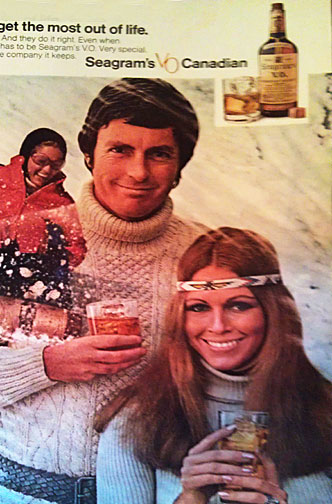
The treatment of alcoholic beverages never seemed to decline over the decades. The promotion of alcohol was typically cast as social-friendly and male-oriented. Advertisements for Scotch, Vodka, and other liquor store delights were often portrayed as the swinging bachelor's preferred sip of choice.
Alcohol in advertising was presented as a lifestyle rather than a mere product. After-hours partying, the cocktail hour, or living the smooth bachelor playboy lifestyle all encompassed the promotion of alcohol. The approach was very successful, refined and tastefully represented. American media in the 1970s beautifully wrapped potentially hazardous products in a prettier, and more acceptable bow.
Sex in Advertising

Throughout the years advertising has always been about sex; this wasn't limited to just the '70s generation. But in the '70s, sexual freedom was just another cornerstone of the '70s foundation. Freedom to live, love, and party peacefully and without limits or judgement was an underlying theme of the decade. Sexually oriented advertising was & and always has been—blatant. The point was to get a man to read the ad. In the ad below the text reads: "The one thing a man never turns down is a second helping of rice." So, what does the blonde-who occupies 75% of the ad-have to with rice?
 Sex, in the form of leggy models with, or without much clothing, was the common focus in much of '70s marketing and advertising. Women were basically used as the objects to sell products which, in some cases, shows a lack of confidence in the product itself. Cars, stereos, liquor, cigarettes, and many other things that men focused on were often accompanied by desirable women somewhere in the photo.
In any event, sex was a driving force behind advertising, appealing to a male audience. Many other ludicrous promos such as the "rice" ad were found gracing many a '70s magazine page.
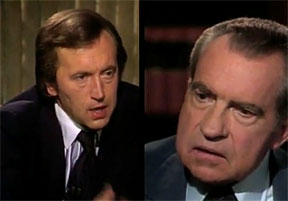
One of the most controversial forms of media
was the talk show, or "report TV". The biggest, and most powerful weapon in '70s media had to be the talk show. There was little territory that was safe, and the new talk show hosts were ruthless with their interviews. David Frost's lengthy interview with former president Richard M. Nixon was one of the world's most-watched shows.
 Pure bravado and classic comic skills were what made Johnny Carson such a number one late-night favorite. His iconic "Tonight Show" was, and still is, legendary. Johnny was an affable easy-going guy whom audiences could warm up to. He also did things above and beyond the call of talk show hosts line of duty such as petting a crocodile and permitting a large tarantula to crawl up his arm. Never before had I seen talk show hosts go the distance that Johnny did.
Along with the interviews, Johnny offered up wonderfully comedic skits and monologues. My favorite was "The Great Carnac". Carnac was an hilarious comic mystic who "divined" his answers before the question was asked.
The Dick Cavett Show was another one that I rarely missed. He had a comic, edgy style, and took no guff from anyone. He asked the questions many others didn't dare ask, and did it all with a smile on his face. Unlike today's interviewers whose techniques are to push guests into a corner with rude questions, Dick Cavett handled his hard queries with pure style and class.
 Cavett also had amazing recovery skills; if the guest turned on him, he could bounce back with comedic right hook without missing a beat.
In my opinion, Dick Cavett was one of the most successful talk show hosts ever. Out of the multitude of guests on his show, my favorite Cavett interviews would have to be with Janis Joplin for whom he seemed to have a sincere affection for. Janis was a lightning bolt, and anwered any question in her own way, without hesitation or concern. One of my favorite questions:
CAVETT: Are there male groupies that follow the female rock stars around?
JOPLIN: Not nearly enough.